
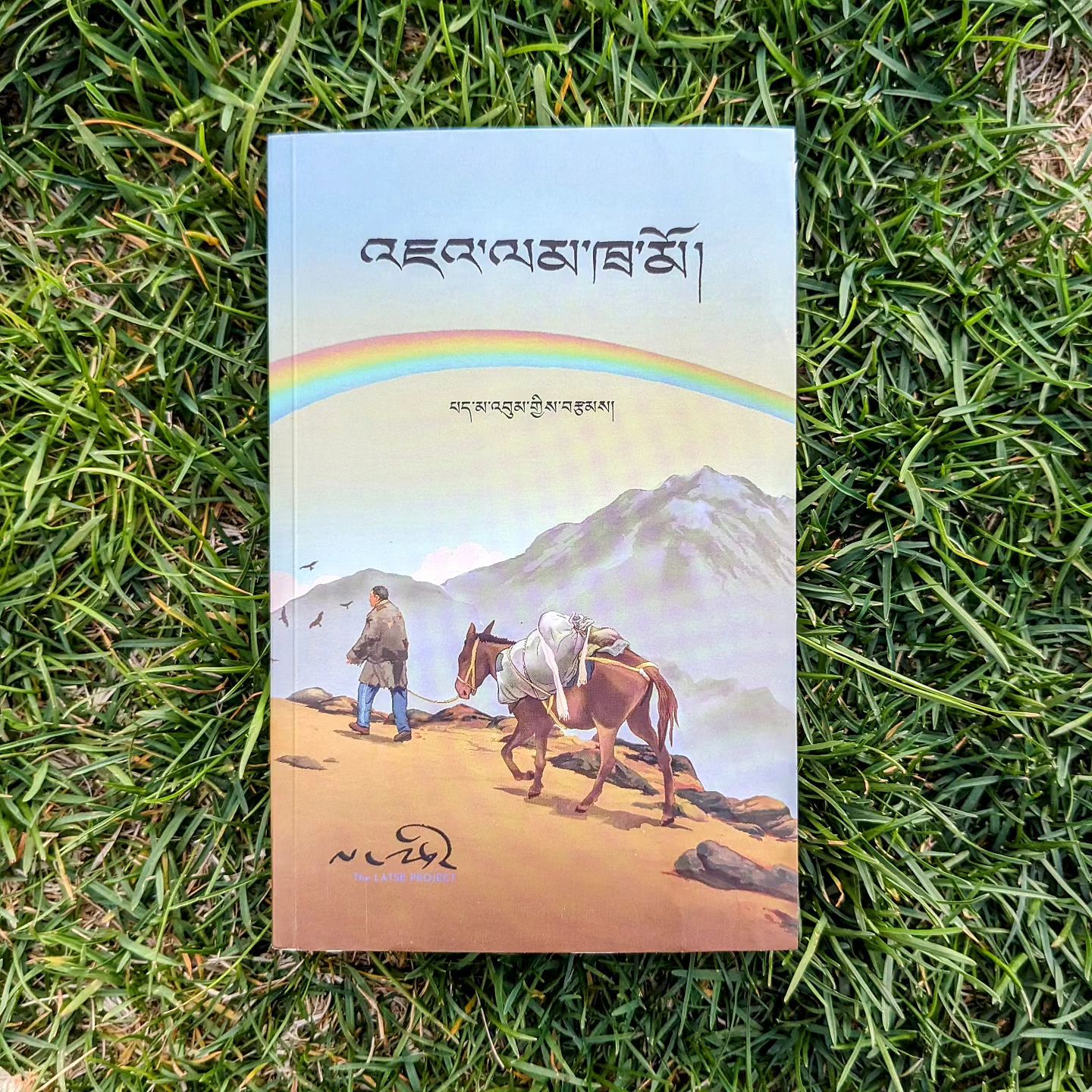

Today, February 10, 2026, marks the official publication day of “Ocean, As Much As Rain – Stories, Lyrical Prose, and Poems from Tibet” by Tsering Woeser, published by Duke University Press, edited and translated by Fiona Sze-Lorrain with Dechen Pemba. The book features cover artwork by Tenzing Rigdol and a foreword by Pankaj Mishra.
We would like to extend our thanks to Kamila Hladíková for the below book review. Scroll to the end for Kamila Hladíková’s short bio and also for information on how to order the book depending on where you are based.
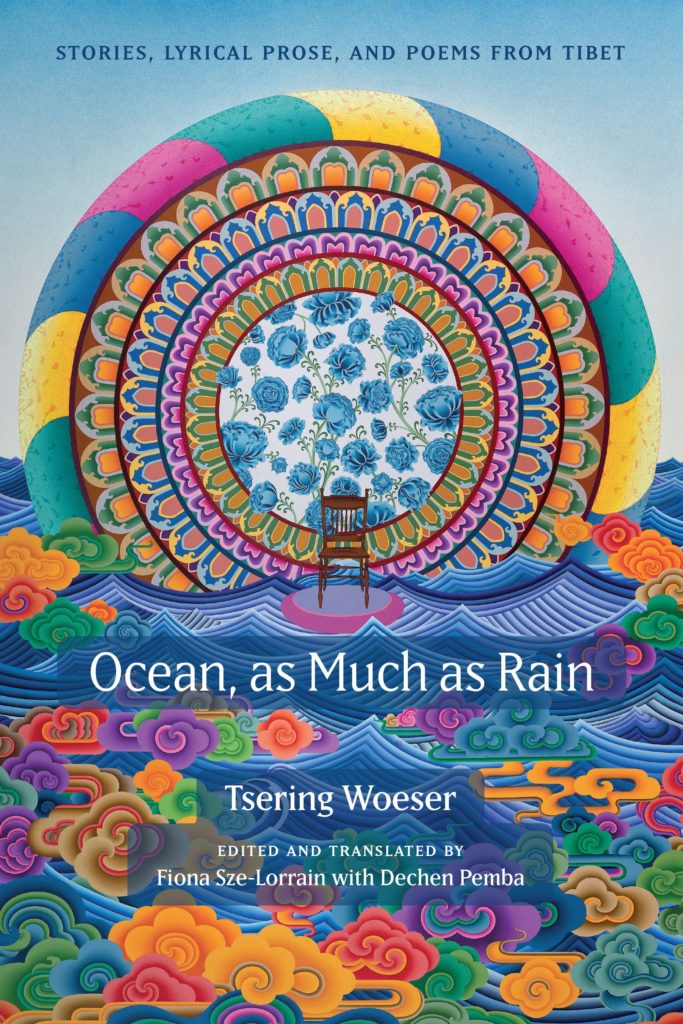
“Ocean, As Much As Rain – Stories, Lyrical Prose, and Poems from Tibet”
By Tsering Woeser: Book Review by Kamila Hladíková
The “Ocean” in the title of the new book of translations of Tsering Woeser’s texts might seem poetic but it in fact refers to something very mundane: the “rain” of silver coins (in Chinese called “dayang”, which also means “ocean”) minted by the Chinese Communist Party in the early 1950s in order to buy Tibetan support for their invasion.
“Ocean, As Much As Rain”, edited and translated by Fiona Sze-Lorrain with Dechen Pemba, includes twenty texts, written over an extended period of time, starting with Woeser’s earliest poetry from the 1990s, to more recent pieces written or re-written shortly before the Covid Pandemic. The publication consists of “stories, lyrical prose, and poems from Tibet”, as the subtitle informs the reader, but at the heart of the book are the longer lyrical prose texts, which, just like the one about the “oceans”, tell the stories of Tibetans in Tibet.
Almost all texts included in this book were at some point previously published, some of them on the website High Peaks Pure Earth but it is still quite surprising that this is the first collection of Woeser’s literary essays in English. Prior translations of Woeser’s work include two books of poetry, several compilations of political commentary were published in English and other Western languages, and Woeser’s monumental book on the Cultural Revolution, using the rare and extremely valuable photographs of her late father Tsering Dorje, Forbidden Memory, was translated into Japanese, French, and finally English. But none of the lyrical essays, perhaps Woeser’s signature literary form that many years ago caused her banishment from the Chinese literary circles and turned her into a dissident (for the benefit of readers around the world) are available till now in English. Her first banned book, Notes on Tibet (Xizang biji, originally published in 2003), was translated only into the Czech language (2015) and the genre is not much known beyond Sinophone literary circles.

The collection opens with an essay in which Woeser describes her education in the post-Cultural Revolution China as a “tongue surgery”, a colonial imposition of a foreign language and culture, illustrated by a photograph of the teenage author with classmates in front of the Southwestern Minority Institute in Chengdu in the early 1980s. The two closing texts are poems, the first being one of Woeser’s earliest works written in 1990 and the second written under the lockdown during the Covid Pandemic, the time, which from the distance of several years can be seen as the symbolic end of one era in recent development in Tibet and the start of a new one, characterized by omnipresent surveillance and almost absolute social control.
Woeser’s essays (biji or sanwen in Chinese) are lyrical and highly subjective, imbued with a specific “irony”, which Fiona Sze-Lorrain in the introduction aptly interprets as a (sub)conscious result or perhaps an intentional reference to the “inherent linguistic and cultural colonization” manifesting in Woeser’s forced adoption of Chinese as the primary language of her literacy and literary creation. The stories she tells in such essays, that of Garpon-La, the head of the Dalai Lama’s music ensemble who was harshly persecuted for twenty-two years following the Lhasa uprising in 1959 and during the Cultural Revolution, or another about the “King of Dzi” Karma Samdrup who in 2010 was sentenced to fifteen years in prison for his effort to preserve Tibetan culture and natural environment, record the fates of real Tibetans living in contemporary Tibet. The “Land of Snows” as lived and described by Tsering Woeser is full of absurdities which include for example a public toilet built, as urban legend goes, especially on the occasion of the former Chancellor of West Germany Helmut Kohl’s 1987 visit to Tibet, but also full of painful memories surviving in numerous ruins marking the landscape as memorials of what the past was like and what has been lost forever.
The book includes an insightful introduction retelling Tsering Woeser’s life story and her development as a writer and poet. The final chapter is an original interview with the author, conducted over several years, with the first part previously published in 2012 and subsequently further expanded in 2018 and 2022–23. What I find extremely useful is the list of all of Woeser’s printed publications, her books in Chinese (since 2003 published in Taiwan) and all books of translations into all languages, including Tibetan. As a pleasant bonus there are around thirty of the author’s photographs taken over the period of more than three decades during her travels in Tibet and interviews with people. The photographs are, along with the texts, arranged into a pattern bridging the past with the present.
While there are many oral narratives, memoirs, and even novels, accessible in English telling the stories of the bygone era, of escapes from Tibet and generational trauma brought along by those who left their native land, never to return, the stories from the heavily-controlled and securitized present-day Tibet are hard to come across. They are in many aspects similar to the stories of exile (and can be called stories of “spiritual exile” as Woeser herself describes her life between Beijing and Lhasa), expressing the same uprootedness and sense of irretrievable loss. Only the dream of the faraway homeland, a bucolic image of childhood landscape and rich cultural tradition passed from one generation to another, which is the background of many diaspora-narratives, is in Woeser’s texts turned into an ugly nightmare, showing people in Tibet not only forced to compromise with the Chinese communist regime, but sometimes even fully adapted to it: like the young generation of rich Tibetan “princes”, children of the new indigenous Party elites, pictured in “The Killing Trip”. The text was written in 2001, in the time when Tibet seemed to be on the way to the Chinese-designed eternal prosperity, that, however, was ultimately shattered by the 2008 Tibetan uprising caused by the accumulated frustration of young Tibetans, sidelined and marginalized in their own land.
In the West, Woeser has been widely known and appreciated as a poet and “activist.” However, I have always seen her primarily as a “witness”, a survivor providing testimony about what she personally, her family, and people in Tibet in general had to come through after what the Chinese authorities label as the “peaceful liberation of Tibetan people.” She formulated it explicitly in one of her essays about Lhasa’s ruins, mapping them as “evidence” of “political violence”, positioning herself as the “eyewitness” (jianzhengzhe), preserving the “hidden geography and history” that the Chinese Communist Party wished to ban and erase from people’s memory. Woeser’s unique position as an insider in Tibet with direct access to places and people and at the same time a brave objective observer have turned her into one of the most valuable Tibetan voices of the first three decades of the twenty-first century.
About Kamila Hladíková
Kamila Hladíková is Assistant Professor of Chinese literature at Palacký University Olomouc, Czech Republic. She graduated from Charles University in Prague and her Ph.D. dissertation thesis focused on representation of Tibet in Chinese and Tibetan literature in the PRC (The Exotic Other and Negotiation of Tibetan Self, 2013). She published academic articles on Chinese Tibet-related literature and film and Sinophone Tibetan literature. Her recent project maps Chinese ideological narratives about Tibet from a historical perspective, based on so-far unexplored primary sources provided by Czechoslovak visitors to Tibet in the 1950s. Her first book of translations of Sinophone Tibetan literature was published in 2005. After the large-scale Tibetan protests in 2008 she started to translate Tsering Woeser’s Notes on Tibet into the Czech language (2015) and published two research articles on Woeser’s literary essays.
“Ocean, As Much As Rain – Stories, Lyrical Prose, and Poems from Tibet” By Tsering Woeser, Edited and Translated by Fiona Sze-Lorrain with Dechen Pemba
Publisher: Duke University Press
Pages: 210
Illustrations: 50
Release Date: February 10, 2026
Author: Tsering Woeser
Editors: Fiona Sze-Lorrain, Dechen Pemba
Translators: Fiona Sze-Lorrain, Dechen Pemba
Contributor: Pankaj Mishra
Cover Art: Tenzing Rigdol
Paper Price: $23.95 / CA$31.95 / £17.99
Hardcover Price: $89.95 / CA$135.95 / £83.00
Paper ISBN: 978-1-4780-3311-0 / Hardcover ISBN: 978-1-4780-2968-7 / eISBN: 978-1-4780-6186-1 / DOI: https://doi.org/10.1215/9781478061861
Purchasing Information
United States, Central/South America: https://www.dukeupress.edu/ocean-as-much-as-rain
Canada: https://utpdistribution.com/9781478033110/ocean-as-much-as-rain/
Asia, Australia, Europe, UK, and elsewhere: https://mngbookshop.co.uk/9781478033110/ocean-as-much-as-rain/
Follow Us!