
High Peaks Pure Earth presents the English translation of a blogpost by acclaimed writer Tsering Döndrup that was written on December 25, 2025 and published on the Chodme literature website on December 27, 2025.
Tsering Döndrup is one of modern Tibet’s most prolific and respected authors. Born in 1961 in Malho (Chinese: Henan) Mongolian Autonomous County in Amdo (Qinghai Province), he published his first story in 1983.
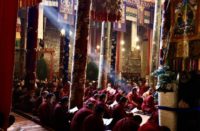
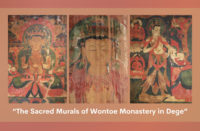
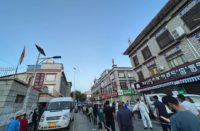
In this piece, Tsering Döndrup summarises his 2025 activities almost month by month, providing an interesting glimpse from the inside into literary life in Tibet. Regular readers will be familiar with the work of Tsering Döndrup from his short stories such as “Baba Baoma” translated by Christopher Peacock who is mentioned in the piece and kindly contributed the two photos. His short story collection “The Handsome Monk and Other Stories” was published by Columbia University Press in 2019.
Most recently, the English translation of his most famous work “The Red Wind Howls” was published in 2025, also by Columbia University Press. Tsering Döndrup mentions that this work was selected among the 2025 Best China Books of 2025 by China Books Review.
Thank you to Françoise Robin for submitting this wonderful piece and translation and also to Palden Gyal and Christopher Peacock for their help.
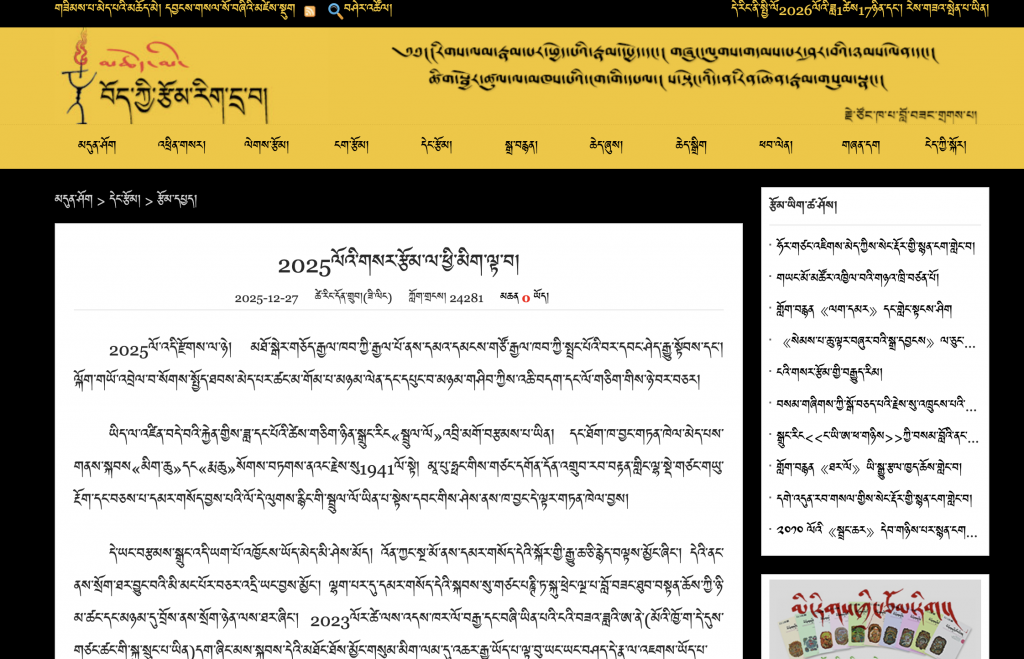
“Looking Back on 2025’s New Writings” By Tsering Döndrup
Translated by Françoise Robin
2025 is coming to a close. From the monarchs of autocratic nations to the beggars in democratic countries, everyone became one year closer to the Lord of Death, walking together, shoulder to shoulder.
I started writing the novel “The Year of the Snake” (སྦྲུལ་ལོ།) on January 1 because it was easy to remember. Initially, I hadn’t decided on a title, so I temporarily named it “Tears and Machu”. However, later, I discovered by chance that 1941, when Ma Bufang slaughtered [the monks of] the monastery of Tsang Dondrup Rabten Ling, along with the entire populace of its dependent village called Tsang Yüngo, was the year of the Snake according to the lunar calendar. So I opted for that title. Although I am not sure if I have been successful in writing this novel, I had long examined all the materials related to this massacre that I could find, I also had interviewed many survivors. In particular, my wife’s aunt, who was 104 years old when she passed away in 2023, was with the Fifth Tsang Pandita, Lobsang Thubten Chökyi Nyima, when he fled and escaped danger. Her husband then was among the bodyguards to the Tsang Pandita. She often spoke vividly about what she saw and experienced during that time, and all this had remained in my memory, allowing me to write with relative ease.
Generally, the terrifying massacre, with its origins, consequences, development, high tide and key figures as well as minor protagonists, is a moving story even without embellishing it on the head and the horns, and I had long wanted to turn this great massacre into a true historical novel, but upon reflection, the main and real characters, the main and real events, the real places, the real time, etc., were all essential conditions for a historical novel. This is the reason why the relationship between the Lama Tsang Pandita and Ma Bufang, the relationship between Tsang Monastery and Labrang Monastery, etc., are not easy to write. Moreover, there are many differences between historical sources and actual events. For example, the great scholar Sungrab Gyatso, who was a monk of Dhitsa Monastery at the time, and served after the Communist takeover as the head of the Department of Education of Qinghai Province and Vice-Chairman of the Qinghai CPPCC, wrote in his “Notes on Things Heard about the Killing and Looting of Tongde Tsang Monastery” (桑热嘉措《杀掠同德藏寺侧闻记》——青海文史资料集粹之民族宗教卷) that a year later, Ma Bufang deceived Lama Tsang Pandita by bringing him back to Tsang Monastery and murdered him by poisoning. In fact, Lama Tsang Pandita passed away in Atati, about fifteen kilometers east of my home area, known now as Yögenyin Town in Malho Sogdzong County, as many elders in this area are aware. I have also interviewed people who attended his funeral. I am convinced that it was not that Sungrab Gyatso did not know about that, but that he was deliberately made to write it this way. Therefore, I have long known that historical books and material can sometimes be less reliable than novels. Under such circumstances, I abandoned the idea of writing a historical novel and wrote it as a fictional novel.
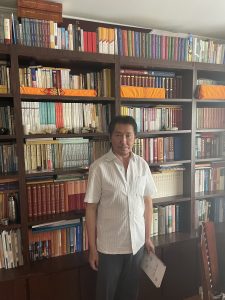
At the end of February, my Japanese [translator], Chime [星泉 – Hoshi Izumi, Tokyo University], came to Xining to discuss and finalize some translations, addressing any doubts encountered during the translation process. After returning to Japan, she contacted the publishing house that had previously published a Japanese translation of my short story collection entitled “Black Fox Valley” and said we needed to sign a publishing contract. Soon afterward, I received the publishing contract and she requested my feedback. I knew that Japanese were meticulous people, but still she was particularly thorough, requiring not only explanations of word meanings but also justifications for them, often leaving me at a loss. She also insisted that her Japanese translation of the folk stories collection “Tales of the Golden Corpse” should be presented to the original publisher, the Qinghai People’s Publishing House, so I accompanied her there. The Vice-Director of the publishing house, a longtime acquaintance of mine, took us to the newly appointed president, so he introduced him and they quickly became familiar with each other, as if they were old acquaintances. I then spoke candidly about how we, despite being the largest nomadic people in the world, still lack a comprehensive dictionary of pastoral terms. This is why, for instance, in my short stories, if I use pastoral vocabulary common in our daily speech, they are not found in dictionaries, causing difficulties for readers, especially young readers. The Mongols, on the other hand, have numerous pastoral dictionaries, and do not face such issues.
A few years ago, under Professor Chime’s guidance, a dictionary called “Tibetan Pastoral Culture Dictionary” was edited and published [in Japan]. You, people of the publishing house, it would be good if you initiated a collaboration with these Japanese people to start by translating that dictionary into Tibetan and then, you could add as many missing entries as possible, and publish it. As they say in ancient biographies, “The minds became one.” I pray that this work will be realized soon.
At the end of March, about one-third of “The Year of the Snake” was completed. The excerpt “The Monk and Abdu” was published on the “Chodme Tibetan Literature” website. I had planned to travel after completing the writing but in early April it is the peach blossom festival in Nyingtri, and my family said they wanted to go there.
Therefore, it was not a problem to temporarily put aside this story and take a break. Especially for me, Central Tibet is like a magnet, and I can’t bear to not go at least once a year, so we took the train to Lhasa. When we arrived in Lhasa, the young scholar Namchukgyal drove a car to welcome us at the railway station. He is very knowledgeable about Tibetan grammar and has sharp eyes. Whenever I write something, if I first show it to him, he hardly ever misses any typos. So, I jokingly call him “Hawk Eyes”. He said that he found his government job meaningless and was very tired of it. If he could live like me, he said, reading, writing, and traveling as he pleases, how happy that would be. I told him that I too had had put up with work for over thirty years for the sake of a monthly salary, as was his present case. When tired of government work, meditate on money! Many people make smoke offerings to gods, and offer backdoors to men, but not everyone can get a job like his, can they? Later, seeing him complain less, I thought perhaps my instruction to meditate on money when tired of government work had produced extraordinary results.
We spent two days leisurely visiting and relaxing. Ju Kalzang had also arrived in Lhasa, so we had a chat over tea and shared a meal. We got to know each other at a literary conference in 1984, and our friendship gradually deepened over the years, now marking its 40th year. Although he has two phones, it’s really difficult to get in touch with him, probably because he’s very busy. Often, publishing houses and magazines are left with no option but to contact him through me. That is why I never fail to tease and joke with him that reaching him is harder than contacting the President of the United States. However, that time, we had made plans to meet in Lhasa early on, so it was easy to get in touch, and I was particularly happy that we were together again, so we went on purpose to the Potala Palace to take a commemorative photo. I suggested that his collection “The Story of the Family Reunion” included in the 4th series of “Yudrukar Collection” could be classified as “versified novel”, and he basically agreed. We also referred to the famous versified novel Eugene Onegin by the Russian poet Pushkin. However, when it was actually published in mid-November, the book title came out just as Ju Kalzang’s Long Narrative Poem, with its Chinese title given as 居·格桑长诗集 [Ju Gesang zhang shiji, Long Poetry Collection], without even the shadow of the word “fiction” or “novel”. Anyway, like his other literary works, this book received a warm welcome from readers, and hardly had a month passed since its release, that the initial print run (2000 copies) was sold out, and a second run was printed.
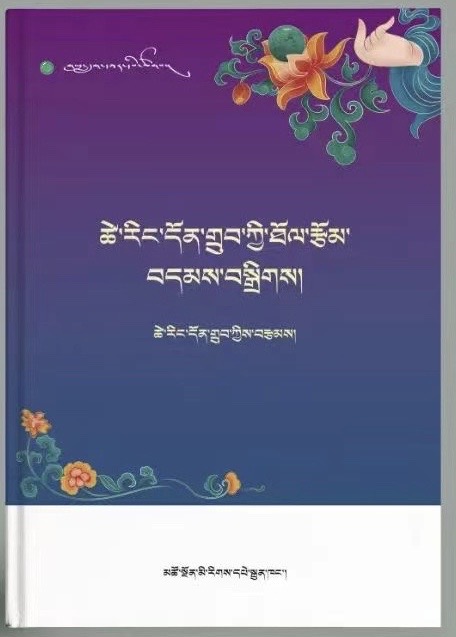
My own “Literary Musings” is also included in this series. Initially, when the publishing house asked me if I had any writing for them, they inquired whether I had some fiction writing [ready for publication]. I replied that I didn’t, but I had enough material for a collection of “literary musings”. They said it would be fine. It comprises twenty-seven literary pieces written from the 1990s until this year, including creative writing, notes for lectures, book reviews, travel notes, and short funny snippets. Honestly, these were not crafted through long-term thinking and numerous revisions like fiction writing, but were rather spontaneous writings only, so my hopes were fairly low but, incredibly enough, the 2,000 copies print run is almost sold out. Apparently, it is the second-best selling book in the series, after Ju Kalzang’s book. I suspect this is due to the praise in the Chinese-language promotion done by the publishing house, according to whom these literary pieces have a distinct literary style, are full of erudition, and humorous. Regardless, I sincerely thank my dear readers.
My arrival in Lhasa, for the city, is as meaningless as a drop of rain, but for me, arriving in Lhasa feels like coming home, and it fills me with happiness and comfort. I especially feel a strong desire to immerse myself in the lap of the mountains, rivers, and forests. After parting with Ju Kalzang, I went for a walk alone in the “Lhalu Marshes”, which are considered as the lungs of Lhasa. Every time I visit this place, exactly as I admire the good nature of the people and the beautiful scenery, I feel disheartened and even angry by garbage, as well as spelling and translation errors, that litter the place. In this pleasant place where various water birds freely roam amidst the reeds, this is how it goes: many introductory texts misidentify the water birds: for example, the Bar-headed Goose (Anser indicus, 斑头雁) is introduced as “Red-headed Duck”. I sighed to myself and returned to the hotel with a heavy heart.
Renting two cars in Lhasa, my family and I traveled to Nyingtri [Nying khri], stopping on the way to view the Bragsum Tso. Back in 2018, there was only one row of ticket booths, but now it has become a small town. At this rate, before long, the place will become so crowded that one cannot but keep wondering if there will still be space enough to set one’s foot, and one cannot escape worrying about it. In Nyingtri, we visited the peach tree gardens, a 3,200-year-old giant cypress tree, and the Southeastern Tibet Cultural Relics Museum, among others. Then, on the way to Powo, we passed through Lunang and visited the ruins of the Kanam Depa’s Palace, a 600-year-old site from Tibet’s ancient [Kanam] kingdom. My traveling experiences about these places are detailed in my “Southern Tibet Notes,” so I won’t repeat them here.
In the summer of 1987, the editorial office of “Tibetan Literature and Art” magazine organized a writers’ group – most of the participants were from central Tibet. Only three were from Amdo: Dong Norde, Machu Konlo, and myself. From then onwards, I became acquainted with some central Tibet writers, and over the years our connection became more frequent and deeper. A few years ago, we set up a WeChat group called the “87 Writers’ Collective,” which includes members who have written or translated 500- to 600-page books, in several volumes. Dong Norde and I have repeatedly invited them, and most of them have only visited Amdo Golog and my hometown once. However, I have often been to central Tibet, and each time they invited me to the best restaurants, and sometimes even booked hotels and paid for the room. Because of this, I had to visit there secretly later. However, this time, I had brought with me a special gift for the writer Tsering Yangkyi: a pirated copy of her book “The Flowers of Lhasa” that I found in a bookstore in Xining, and I felt she absolutely had to see it.
Since “The Flowers of Lhasa” was printed in 2016, it has totaled seven editions and the overall print run has reached 39,000 copies. Given that each book costs 28 Yuan, this represents a total of 1,092,000 Yuan. I do not know how many counterfeit copies have been printed, and who knows if some other bootleg books exist. No one is more heartless than people who make and sell these counterfeit books. However, considering things coldly, in today’s world and in this place, it’s quite normal for products that are genuine to also have counterfeits. Moreover, the existence of a book counterfeiter is a sign that the book has value and is in high demand. Therefore, I told her, both jokingly and to offer her some solace, “Congratulations on your book being pirated.”
In fact, before going to Nyingtri, I had already met the writers Tashi Palden and Tsering Yangkyi, and offered her the pirated copy, so, after returning from Nyingtri, as we had agreed, we met leisurely. Both had invited Samshopa Konchok Yondan, Pelha, and Chungdag, who were members of the “87 Writers’s Collective” and were then in Lhasa. They were waiting for us in a nice restaurant. They also invited the poets Jampa Tenzin and the playwright of the Tibet Drama House, Nyima Dondrup, as well as others, and I wish to thank them all for the happy time with songs and dances we spent together.
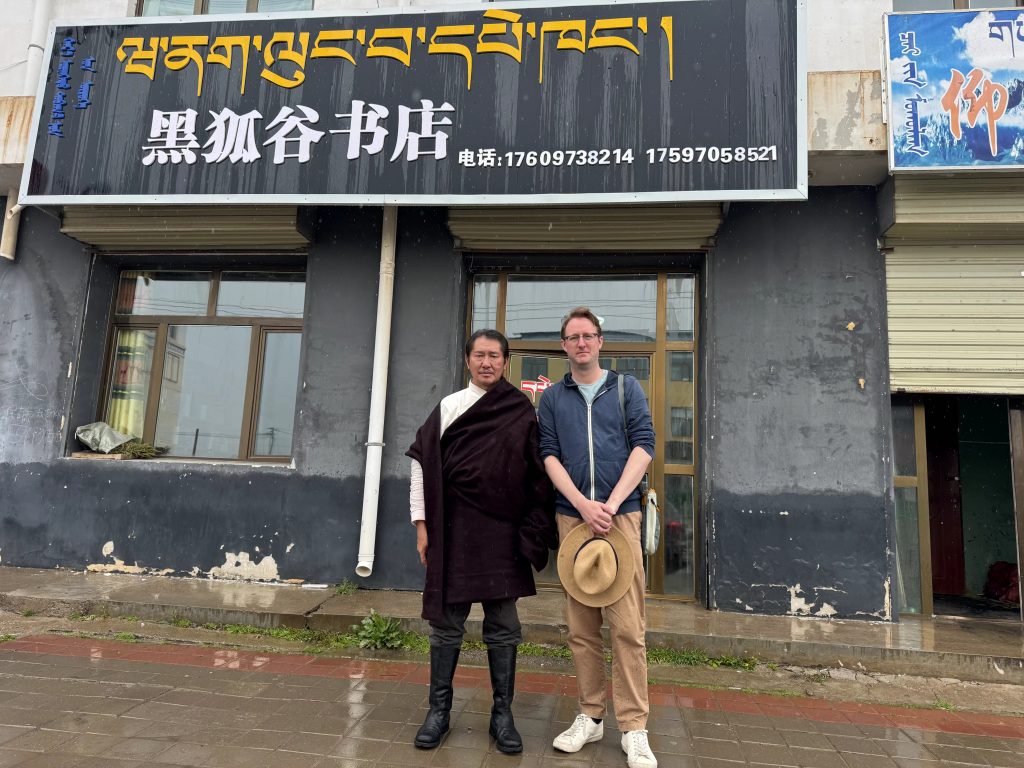
After returning from central Tibet, I kept writing “The Year of the Snake” and in early June, Mr. Christopher Peacock, who had translated two of my books into English, arrived in Xining, bringing with him the translation of a novel published by Columbia University Press in the United States this year.
As, at that very moment, I was invited to participate in an event in my hometown, the two of us went to my hometown. Needless to say, on the way, we talked about literature, especially Tibetan literature, and even more so fiction. He said that Tibetan fiction still had to develop, but a very few works can definitely be considered among the best in the world. Not only had my French translator, Françoise Robin, made a similar statement in the past, but she added that Tibetan novels had developed greatly in the short span of forty years, from nothing to something and from merely existing to being quite good, and that such a development is probably rare in the world. At that time, I was not that confident at all, and even laughed. But later, her translation of my novel won a French literary award, and sold well, because a “paperback version” that could fit into a pocket was also published. My conversation with Chris reminded me that, at that time, she had asked me if I was still laughing. Christopher is now a literature professor at an American university, mainly teaching modern Tibetan literature. Also, although it is called a “lecture”, the teacher mainly recommends to the students some works which he thinks have such and such characteristics and values, and after the students have personally read the work, they debate about their own opinions, and it is unthinkable they do as in our literary courses where the teacher says, “The meaning of this work is this, the style and symbolism is that,” leaving no room for debate.
At the end of June, I completed the novel “The Year of the Snake” and sent it to the young novelist Yungok Tsetra, as well as to the aforementioned friend “Hawk Eyes,” and the learned monk Zopa Gyatso, to gather their views. They corrected typos and I wish to thank them for their valuable suggestions. Then, I was invited again and again by Norpal Gyal, who, without ever having been to school, became literate by self-study alone, read countless books, published four books, is an educated herder who owns a large book collection, including the complete Kangyur and Tengyur. So my wife and I, along with a friend, went to his home in Yakmo Village in Kangtsa County. Then, we went to a scenic spot with a hot spring at the source of the Dala River, by the shores of Kokonor Lake, a spot which is managed by the community itself, which does not let anyone else handle it. I talked with the village officials and we took photos in memory. At noon, Norpal Gyal pitched up a cotton tent by the lake and warmly entertained us. The weather was great that day, so we cooked mutton, boiled milk tea, ate and drank while enjoying the scenery of Kokonor Lake. We exchanged views about the books we had read, and talked about the grass and plants in our home place, etc. He said that white gentians did not grow in this place, so I told him he should definitely come to see them in my hometown someday. Conversation turns strangers into acquaintances, acquaintances into old friends. While talking, we discovered that we were the same age. He has read many more Tibetan books than I have, and most importantly, I was impressed that he has his own opinion and is not the type to blindly follow others. At the same time as I was thinking that if one day I could break my “iron bowl” and, like him, read and scribble down while herding a few cattle and sheep, I recalled how until I was 13, I was a herder. Then, I felt sorry for many youngsters who, upon graduating, will not return home to farm and herd, but instead work as humble waiters in towns.
I did the final revision of “The Year of the Snake” in September. At the end of that month, I submitted it to Qinghai Ethnic Publishing House with a brief summary in Chinese. They generously asked me whether it should be included in the “Novels” series or published as a standalone book, what format the book should be, adding that it would be printed according to my preference.
On December 20, i.e. the morning of the winter solstice according to the traditional calendar, news reached me from across the vast ocean: in 2025, six hundred and fifty-five English translations of China-related books had been published in America. Among these, ten non-fiction books and ten literary works received particular praise, and my long novel ranked among the latter. This is not just a recognition of my own literary work, but a high recognition of Tibetan literature. More importantly, the fact that the Tibetan language exists and flourishes on the other side of the vast ocean deeply moved me, and I blurted out, “My thirty consonants may be absent in the East, but they are present in the West.” Then I swiftly moved on to write this summary of 2025, mainly focusing on contemporary literature.
2025.12.25
Follow Us!